DPRTE 2025
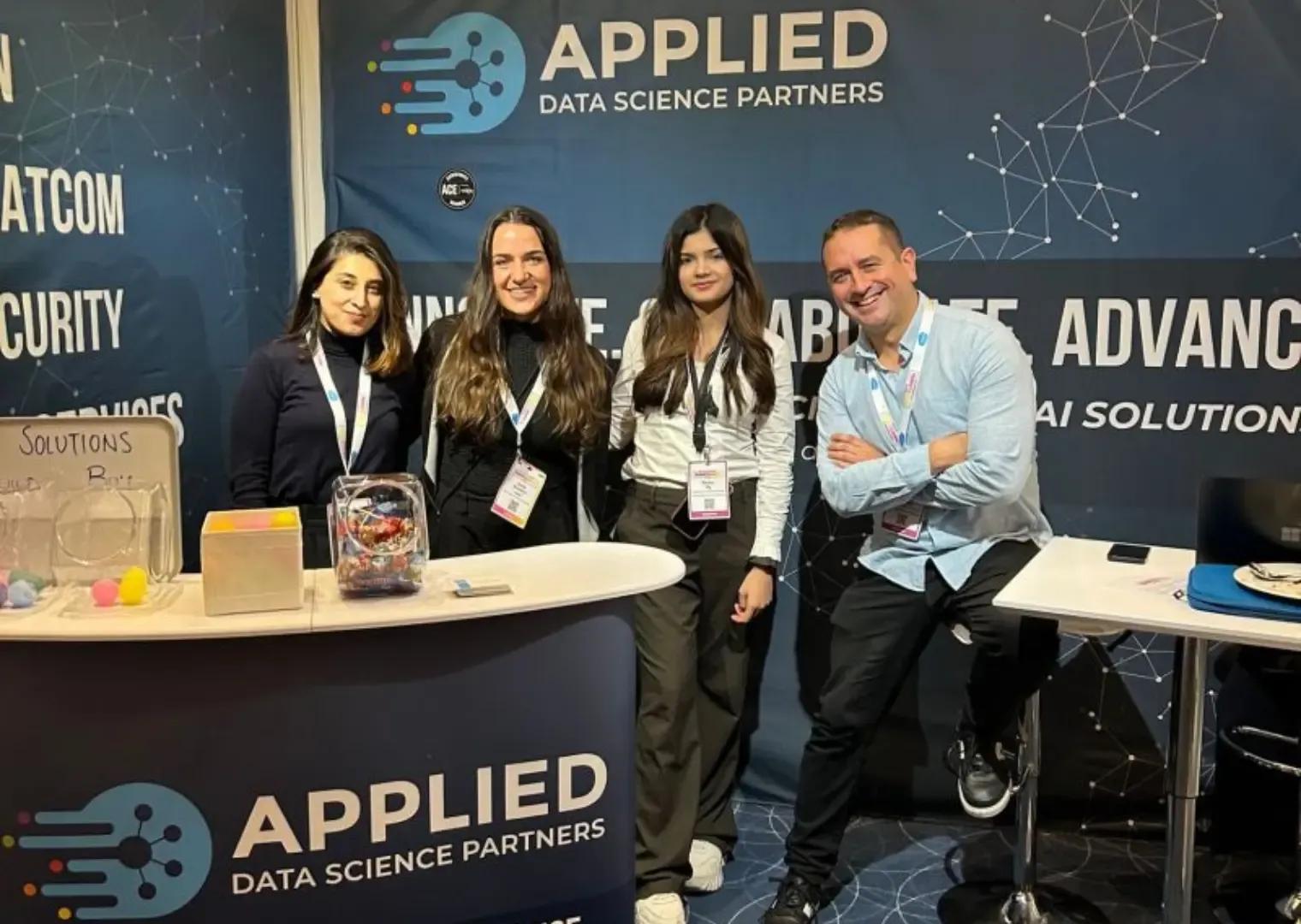
Pre-book your meeting with the ADSP Team, exhibiting at stand 138 at DPRTE!

A Brief Introduction to ADSP
Applied Data Science Partners (ADSP) is at the forefront of AI and ML innovations in cyber defence. Founded in 2016, ADSP has consistently delivered high-impact data science solutions to enhance security and defence strategies. Our team comprises experienced data engineers, data scientists, and data architects dedicated to developing state-of-the-art and interpretable AI models tailored to our clients' unique needs.
Our Frameworks






Event Overview

DPRTE 2025 is the UK’s leading defence procurement and supply chain event, offering a dynamic platform for defence suppliers to engage with key stakeholders and explore the latest technological advancements.
Over two days, attendees will have the opportunity to network, participate in workshops, and attend keynote presentations, gaining critical insights into current trends and future opportunities in the defence sector.
ADSP and the MOD
Over the past few years, ADSP has successfully delivered several AI projects for the MOD, playing a pivotal role in advancing AI and ML techniques in cyber defence. Our key contributions include:
LLM Agents for Cyber Defence: A Zero-Shot Approach
Task 37: Investigated using LLMs as defence agents to reduce reliance on traditional training methods, demonstrating a 90%-win rate on specific environments.
 Task 32: Aims to review the evolving LLM landscape, focusing on reducing latency and expanding memory options to enhance agent performance.
A Generalist RL Agent for Cyber Defence
Task 18: Demonstrated the creation of a single, versatile agent capable of effectively operating across multiple cyber environments.
- Task 40: Created adaptors to streamline RL projects and demonstrate the potential to integrate and analyse various RL models efficiently.
Minimum Viable Product (MVP) Agent Integration
Task 8: Implemented the first integration of a pioneer agent into complex environments, leading to the demonstration of an ML cyber defender outperforming a rules-based agent developed with a human analyst.
- Task 19: Showcased that RL could learn to handle more complex simulation environments, achieving a milestone in addressing the Sim-to-Real challenge.
Decoy Agents: A Generative Approach to Deception
Task 36: Explored the efficacy of using Large Language Models (LLMs) to create realistic decoys to deceive attackers and deflect from intended targets.
Talk-To-Your-Components: Human Programming Interfaces
Task 38: Demonstrated LLMs equipped with retrieval augmented generation (RAG) to interpret complex cybersecurity data into human-readable output.
Probabilistic Graphical Models for Agent Planning
Task 49: Implements a probabilistic graphical model to allow the agent to select actions with a higher likelihood of success, anticipating outcomes.
Data Efficient Reinforced Learning
Task 17: Proved the ability for the Self-Predictive Representations (SPR) technique to generalise better to unseen tasks more effectively than traditional RL techniques.
Defence Environment Simulations
Task 28: Enabled testing and validation of defence agents in complex cyber environments, enhancing adaptability and effectiveness.
Extending Reinforced Learning Capabilities
Task 50: Focuses on extending and developing proof-of-concept agent and environment adaptors, enabling other groups to utilise the adaptor functionality.

Secure by Design