
What Makes AI Agents Different from Chatbots?
From chatbots to AI Agents: understanding the next generation of intelligent automation.
.webp&w=3840&q=75)
Understanding the Evolution: From Chatbots to AI Agents
Early chatbots first appeared in the 1960s with scripted systems like ELIZA and later ALICE, which relied on pattern matching and rule-based responses. By the 2010s, organisations widely adopted content-based chatbots to manage greetings, FAQs, and simple support routing across websites and service channels.
The next major shift arrived in 2022 with the rise of Large Language Models (LLM)-powered chatbots following the release of ChatGPT. These hybrid systems were far more conversational and adaptable than rule-based bots, yet they remained reactive tools that responded to prompts rather than taking initiative.
-1.webp&w=3840&q=75)
With the rise of agentic AI, powered by LLMs like GPT-4 and GPT-5, we’ve entered a new paradigm. Unlike traditional chatbots, AI Agents don’t just converse; they understand context, make decisions, and take goal-oriented actions.
“Autonomous systems, including physical robots and digital agents, are moving from pilot projects to practical applications… they’re starting to learn, adapt, and collaborate” (McKinsey, 2025).
What’s Changing in Conversational AI?
Conversational AI has entered a new phase. Traditional chatbots, once celebrated for automating basic conversations, are now being surpassed by a more capable generation of intelligent systems: AI Agents. Unlike chatbots, which primarily react to user prompts, agents can understand context, form plans, and take meaningful action across tools and platforms. While conversational AI encompasses everything from early chatbots to modern agents, AI Agents represent the most advanced stage of this evolution, shifting from conversational assistance to autonomous task execution.
Why This Matters
This shift matters because organisations are no longer adopting conversational AI simply to answer questions. AI Agents extend automation into workflows, analytics, and strategic decision-making. According to PwC’s AI Agent Survey 2025, 79% of executives say AI Agents are already being adopted in their companies, and 66% report measurable productivity gains (PwC, 2025). These early results show the leap from reactive chatbots to proactive, goal-oriented systems.
.webp&w=3840&q=75)
This transition marks the evolution from conversational automation to true operational intelligence. Autonomous digital systems are “starting to learn, adapt, and collaborate” (McKinsey, 2025) in practical business environments.
To understand this shift clearly, the rest of this article explores five key differences that separate AI Agents from chatbots and why these differences matter for organisations adopting the next wave of AI.
#1: Reactive vs. Proactive Intelligence
Chatbots and AI Agents may appear similar on the surface, but their underlying design principles are fundamentally different. Chatbots are built to respond, while agents are built to achieve. This shift from reactive interaction to proactive goal completion is what defines the leap from traditional automation to agentic intelligence. The table below highlights the key distinctions between the two systems.
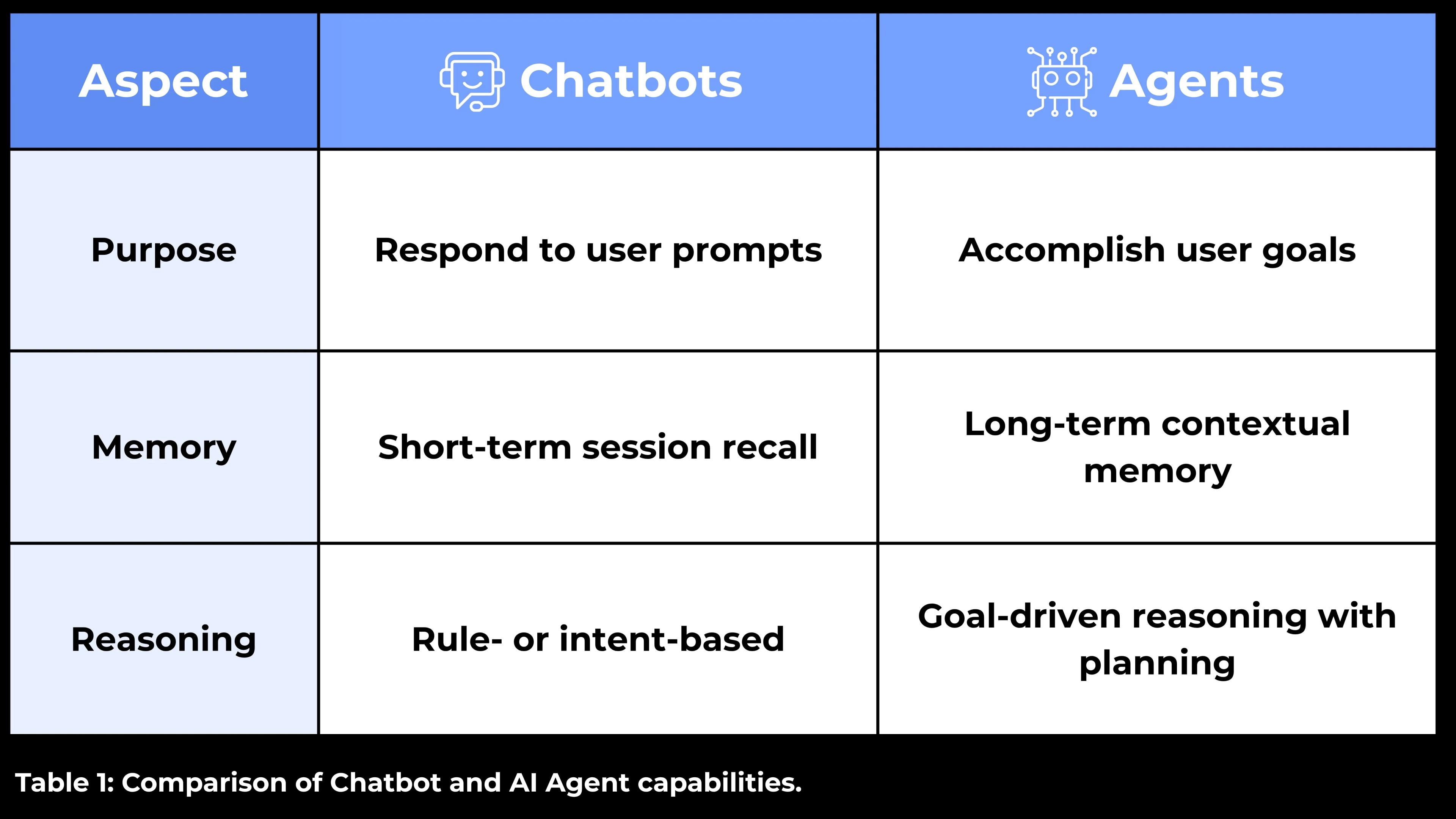
“Autonomy has become one of the defining qualities of modern agentic systems" (Archarya et al., 2025), enabling them to move between tasks and adapt to shifting goals. This shift is reflected in the core distinctions between chatbots and AI Agents, and the table illustrates how agents extend far beyond simple replies by operating with deeper memory and purposeful reasoning.
#2: Integration and Ecosystem Intelligence
Chatbots typically operate within a single environment such as a website or messaging platform. AI Agents go much further. They work across integrated ecosystems, connecting with CRMs, CMSs, analytics tools, and workflow systems to orchestrate actions end to end. “Agentic AI represents a leap forward in AI capabilities and market opportunity… enhancing resource efficiency, automating complex tasks, and introducing new business innovations” (Gartner, 2025).
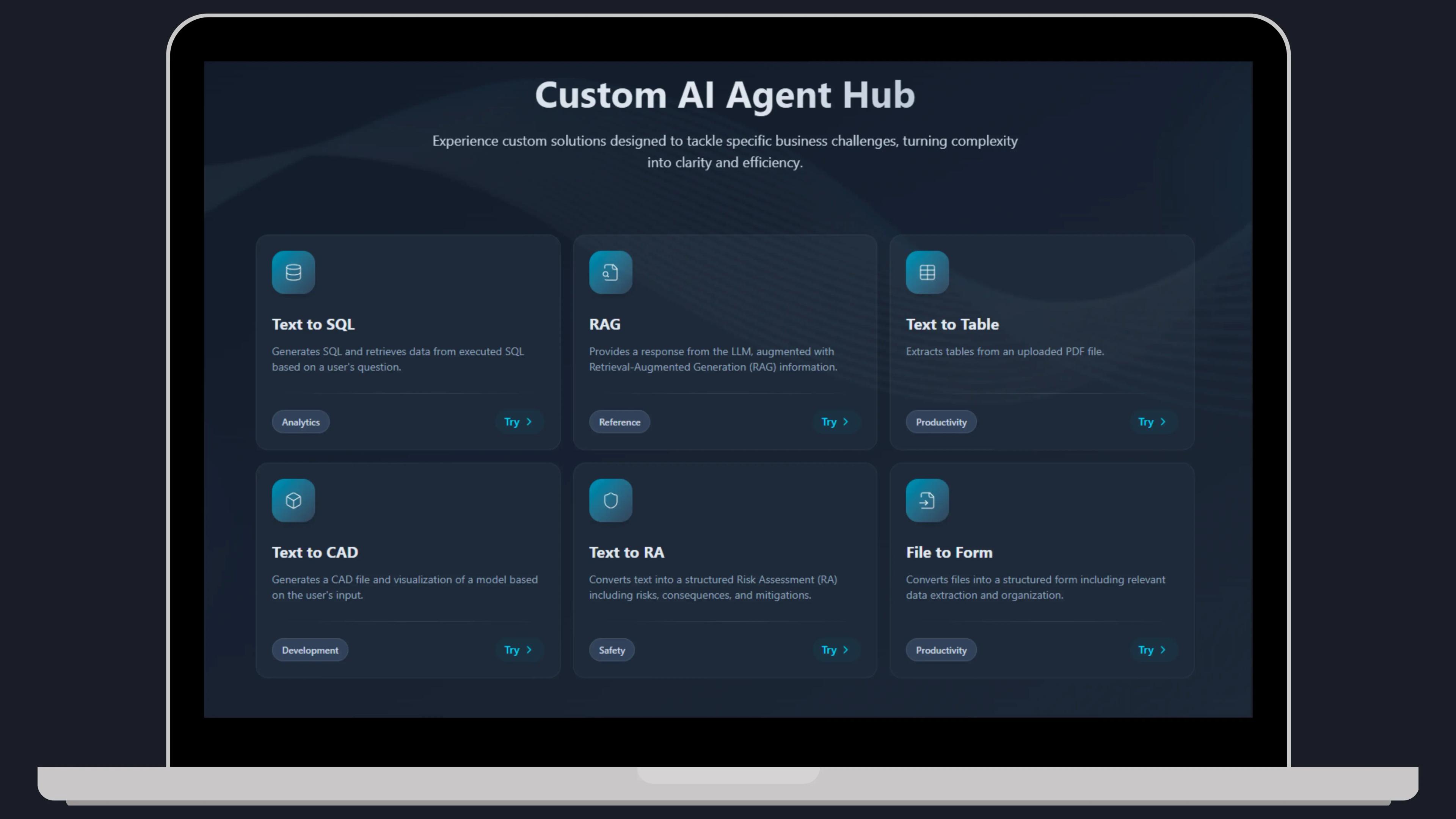
This interoperability enables autonomous workflow execution rather than simple response automation. To demonstrate how this integration works in practice, the following example highlights a platform built around this agentic architecture.
#3: Learning and Adaptation

Chatbots only improve when developers manually update their scripts. AI Agents, however, evolve through experience. They learn by using feedback loops and reinforcement learning to refine their behaviour over time. As they operate, they record the outcomes of their actions and adjust their strategies accordingly.
They also incorporate real-time external data, which helps them respond to changing conditions. Through this continuous optimisation, AI Agents become more efficient and more accurate with each iteration.
#4: Reasoning, Planning, and Execution
AI Agents combine LLM reasoning with real-world tool access, allowing them to query data, plan multi-step actions, and execute tasks across different systems. For example, a chatbot can answer a simple question such as “What’s our current campaign performance?” An AI Agent can go much further. It can pull fresh metrics from analytics platforms, generate a full performance report, and produce an executive summary with recommendations for improvement, all without additional prompts.

This ability is driven by architectures like ReAct (Reason + Act) and AutoGPT-style planning loops, allowing agents to self-evaluate and iterate without manual oversight. “The value that agents can unlock comes from their potential to automate a long tail of complex use cases characterised by highly variable inputs and outputs — use cases that have historically been difficult to address in a cost- or time-efficient manner” (McKinsey, 2024).
#5: Autonomy and Governance
As autonomy grows, governance becomes critical. Unlike chatbots with predictable rules, AI Agents operate independently and require transparent oversight. “Integrating agents into legacy systems can be technically complex… In many cases, rethinking workflows with agentic AI from the ground up is the ideal path to successful implementation” (Gartner, 2025).

Successful agentic AI deployment depends on strong governance. This includes setting clear role-based permissions, testing new behaviours in sandboxed environments, and using human-in-the-loop checks for sensitive actions. Transparent logging is also essential so organisations can see what an agent did and why.
These measures ensure agents operate safely and predictably. Ultimately, good governance turns autonomy into trust. The key difference between responsible and merely capable AI systems.
The Business Case: Data, Efficiency, and ROI
PwC’s 2025 survey shows nearly 88% of executives plan to increase AI-related budgets this year, with 66% already reporting productivity gains and 57% citing cost savings (PwC, 2025). These figures highlight how agentic AI is moving beyond experimentation into measurable value creation. McKinsey’s data supports this trajectory and portrays that "Twenty-three percent of respondents report their organizations are scaling an agentic AI system somewhere in their enterprises, and an additional 39 percent say they have begun experimenting with AI agents" (McKinsey, 2025).
Real-world deployments from ADSP reflect this shift. Organisations are using agents to streamline operations, coordinate information across systems and improve accuracy in areas such as analysis, workflow management and supply-chain execution. Examples include Barton Peveril Sixth Form College, where more than 15 custom agents save an estimated 6,500 hours each year, a multi-agent orchestrator achieving 96 percent coordination accuracy, and a packing-verification system that improves dispatch precision by identifying missing items. AI Agents also drive strategic efficiency: coordinating multiple processes, accelerating analysis, and reducing human bottlenecks. The result is not just automation, but orchestration, transforming how work itself is structured.
Examples of Agentic AI in Practice

Transforming Academia with AI
Discover how Barton Peveril College leveraged AI to save 6,500 hours annually.

Integrating Multiple AI Agents with a Central Orchestrator
Unifying AI agents with a central orchestrator to streamline operations.

AI Powered Packing Verification
Detect missing or obscured items with AI for error-free e-commerce deliveries.
Risks and Readiness
Despite rapid progress, Gartner's 2025 forecast warns that up to 40% of agentic AI projects could be cancelled by 2027 due to poor integration, weak governance, or unclear ROI (Gartner, 2025). To avoid these outcomes, organisations need a clear foundation that supports responsible, long-term adoption. This foundation is shaped by three core pillars that guide how agentic systems are designed, deployed, and managed.
Codified Knowledge
Well-documented processes, rules and workflows give agents a structured foundation to learn from. This improves decision consistency and reduces unpredictable behaviour.
 Example: An agent follows a mapped approval workflow for campaign sign-off.
Strategic Technology Planning
Strong infrastructure and clean system integration keep data reliable and reduce errors caused by disconnected tools.
- Example: CRM, CMS and analytics tools share real-time data with the agent.
Human Oversight
Human review for sensitive tasks ensures ethical decision-making and maintains operational control. It also provides a safeguard as agents operate with greater autonomy.
- Example: A human approves financial actions before execution.
Looking Ahead: The Agentic Era

As generative AI evolves, agents will likely become as commonplace as chatbots once were — but far more capable. They won’t just handle conversations; they’ll run operations. “Agentic AI is moving toward broad deployment… acting as virtual co-workers among other skills” (McKinsey, 2025).
Forward-thinking organisations are already investing in platforms that support multi-agent collaboration and data-driven orchestration. Solutions like the ADSP Agent Hub demonstrate this shift, showing how unified frameworks can bring AI Agents together to work intelligently toward shared business goals.
Conclusion: From Conversation to Collaboration
Chatbots transformed communication; AI Agents are transforming work itself. The leap from reactive response to autonomous reasoning marks a fundamental evolution in digital intelligence. The organisations that embrace agentic AI early and build strong governance around it will define the next era of intelligent operations.
In summary: Chatbots answer. AI Agents understand, plan, and deliver.

Ready to Unlock the Power of Agentic AI?
Book a demo call to explore how custom agents can transform your operations.
Discover more AI Insights and Blogs

AI Governance - All you need to know
Learn the essentials of ethical AI governance to build secure and transparent AI systems.

How AI in Supply Chains is Quietly Revolutionising Global Operations
Discover how AI strengthens supply chain resilience and speeds up logistics decisions.

5 Real-World Use Cases for Generative AI in Retail
Discover how Gen AI improves customer experience and smarter stock decisions.
References
Archarya, D. B., Kuppan, K., & Divya, B. (2025). Agentic AI: Autonomous Intelligence for Complex Goals—A Comprehensive Survey. IEEE Access, 13, 18912-18936. IEEE Xplore logo - Link to home. 10.1109/ACCESS.2025.3532853