
Transforming Satellite Communications Design with Generative AI
Delivering next-generation satellite design with the European Space Agency.
Accelerating Design Cycles and Innovation with Generative AI
Applied Data Science Partners (ADSP) led a pioneering project for the European Space Agency (ESA) to advance satellite communications design with generative AI. By examining state-of-the-art AI tools and methods from multiple industries, our team identified how best to adapt and implement these technologies for rapid, efficient design for the unique requirements of satellite communications.
Challenge
Slow, expensive manual design processes and restricted data availability hinders efficiency and innovation in satellite component design.

What We Did
Delivered three key proof-of-concepts: a generatively designed choke-ring antenna, a text-to-CAD tool and a fine-tuned stable diffusion model, each tailored to satellite communications.
Future Vision & Roadmap
Outlined a practical plan for integrating these tools into SatCom design, including future development opportunities and risks for an end-to-end generative design system, harnessing deep neural networks, LLM-driven text-to-CAD, and image generation techniques.
Key Challenges
Effective application of generative AI solutions to engineering problems needs domain-specific insight. This project required the integration of expertise from both ADSP as AI experts and satellite communications expert partners, working collaboratively to ensure rapid iteration and clear communication throughout.
Additionally, satellite communications present particularly high demands for precision -solutions must be both innovative and rigorous, as only fully accurate, verifiable results are able to be implemented. We took pride in not just pushing the boundaries of what generative AI can achieve, but in reliably delivering robust, real-world outcomes.
The three proof-of-concept generative AI outcomes resulted from this project:
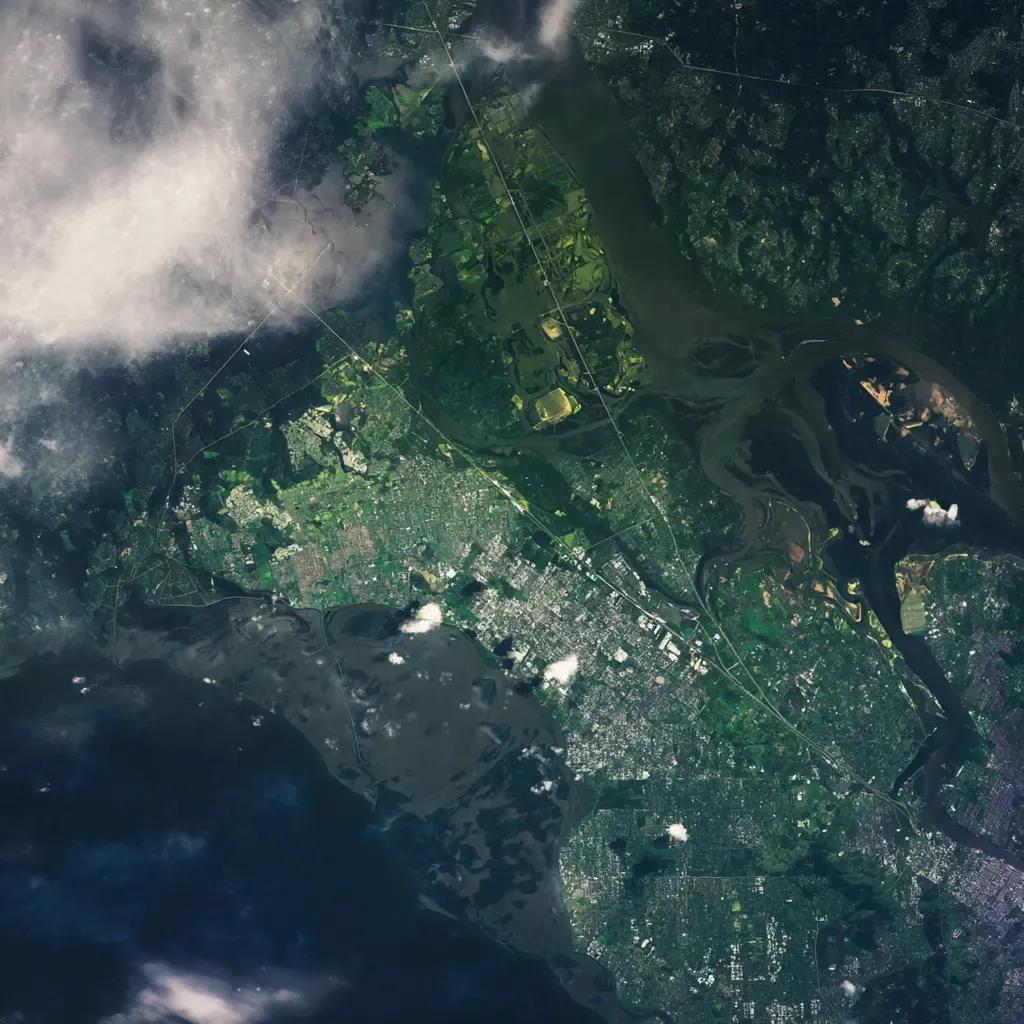
💠 Novel Choke-Ring Antenna Design Optimisation: Neural networks were trained on programmatically generated datasets, encoding both the design and key performance metrics. These neural networks were used to generate novel results that would improve performance.
💠 Text-to-CAD Web App: A web application powered by large language models (LLMs) and OpenSCAD, enabling the rapid conversion of text-based specifications into accurate, parametric 3D models. The tool leverages Retrieval Augmented Generation to further enhance design sophistication.
💠 Fine-Tuned Stable Diffusion Model: Trained on a curated set of approximately 80 satellite images, this model generates and adapts satellite imagery, demonstrating strong learning capabilities and practical adaptability.
Key Benefits
Generative AI unlocks creativity and efficiency in satellite design by exploring unconventional design spaces, reducing repetitive engineering workflows and increasing the speed of design iteration. Key benefits demonstrated through this project include: 📡Improved Performance: Created using a variational autoencoder, the best performing antenna design achieved greater angular range in transmission and reception compared to the industry baseline, while maintaining acceptable cross-polarisation discrimination. Simulation results were validated by physical tests.
⚡Rapid Iteration: 3D CAD designs that could previously take 2–3 working days were created in under 20 minutes.
🛡️Enhanced Reliability: Code execution rates for LLM-generated CAD models reached between 80–100%, rising to 95% with self-evaluation modules.
How we did it?
Over nine months, ADSP worked closely with satellite communications experts to explore how generative AI could be responsibly embedded into real-world engineering workflows. The project mapped both the opportunities and challenges of applying these technologies to SatCom design, laying the foundations for future adoption.
Exploration & Discovery
We evaluated the generative AI landscape to identify where these technologies could deliver real impact in SatCom design.
 Surveyed state-of-the-art generative AI techniques
- Identified high-value applications within satellite communications
Design & Development
We translated insight into practice through rapid iteration, model development, and technical validation.
- Developed and iteratively refined AI models
- Assessed hardware and deployment requirements
Integration & Readiness
We ensured solutions were viable in real environments by addressing organisational, legal, and programme considerations.
- Facilitated close collaboration between AI and SatCom experts
- Reviewed legal, governance, and programme gaps for generative AI adoption

Ready to Unlock the Power of Agentic AI?
Book a demo call to explore how custom agents can transform your operations.
Discover more AI Insights and Blogs
.webp&w=3840&q=75)
What Makes AI Agents Different from Chatbots?
From chatbots to AI Agents: understanding the next generation of intelligent automation.

AI Governance - All you need to know
Learn the essentials of ethical AI governance to build secure and transparent AI systems.

How AI in Supply Chains is Quietly Revolutionising Global Operations
An inside look at the AI strategies reshaping operations across global supply chains.