
AI Trends in 2026: 10 Ways AI Is Reshaping UK Businesses Right Now
A practical look at how UK organisations are turning AI into real operational impact.

2026 is the year AI becomes operational across UK organisations. Regulation is tightening, economic conditions remain volatile and leaders are under pressure to use AI in ways that genuinely improve performance rather than chase headlines. At the same time, the technology itself is maturing fast. Models are more capable, agents are more autonomous and AI is reaching deeper into everyday workflows. With energy usage rising, concerns about job displacement growing and enterprises facing ongoing economic pressure, the urgency to adopt AI responsibly has never been greater.
Most leaders say the hardest part is not the technology but knowing where real value is emerging. According to the DSIT AI Adoption Research 2026, UK businesses show strong awareness of AI but uneven adoption across regions and sectors, which makes it harder for leaders to judge where to begin. The competitive advantage is no longer having AI. It is operationalising it faster than your competitors. This article focuses on the ten trends that sit at the intersection of breakthrough innovation, business strategy and practical use cases already showing results inside UK organisations.
1. Agentic AI moves from Prototypes to Real Workflows
Agentic systems are now capable of performing multi‑step tasks that used to require several people and several tools. Instead of simply generating text, these agents read incoming information, decide what to do next, take action and check their own work. For organisations, this shifts AI from being a helpful assistant to an operational colleague.

McKinsey’s 2026 perspective on operational AI notes that organisations moving beyond pilots into agentic workflows often report noticeable improvements in workflow speed and coordination, as agents begin to reliably close tickets, escalate exceptions and automate handoffs. For example, an ecommerce company can now process most incoming order emails automatically, with the agent reading the request, updating internal systems and drafting the customer reply.
2. Multi‑Model Strategies Replace the old “one platform” Approach
As organisations adopt AI across more workflows, the idea of using a single all‑purpose assistant breaks down. Teams are now using orchestrated groups of agents, each with their own specialism. This mirrors how real departments work. One agent retrieves data, another checks accuracy, another generates content and another enforces compliance. The strategic decision for leaders is how these agents collaborate, which rules govern them and how they’re monitored.
.webp&w=3840&q=75)
In the UK market, many organisations are now using structured AI governance frameworks to oversee this orchestration and reduce operational risk. In more advanced deployments, a central orchestrator acts as a conductor, coordinating the right agent at the right time. This is already transforming internal processes like document review and policy checks across sectors such as finance and professional services.
3. Smaller, Domain‑Tuned Models make AI more Practical and Affordable
The early wave of AI relied heavily on very large, general models. Today, industry‑specific and task‑specific models are catching up fast. They are cheaper to run, easier to deploy internally and often more accurate for specialist work. This lets organisations adopt a multi‑model strategy where each tool plays a different role. Leaders are now choosing models based on data locality, risk, cost and the sensitivity of the workflow, which is particularly relevant for UK organisations with strict compliance expectations. In areas like insurance or healthcare, smaller fine‑tuned models can handle claims, triage queries or draft clinical‑style summaries with greater consistency than generic tools.
4. Customer Experience AI becomes Operational rather than Experimental

Sophisticated AI interactions are becoming a normal part of customer service. Businesses are using conversational agents to answer questions, personalise recommendations and reduce handling time. The technology has matured to a point where customers often cannot tell if they’re speaking to a human or an AI system. This raises the bar for every organisation using enterprise AI to streamline service. Many UK companies now use AI to triage customer queries, prepare draft responses for staff or give personalised product suggestions. Retailers, for example, are training models on customer behaviour to generate more relevant offers and reduce cart abandonment.
5. AI takes Centre Stage in Cybersecurity and Resilience

AI has become an essential defence in cybersecurity, but it is also powering a new wave of attacks. Threat actors now use AI to automate phishing, generate malware variants and scan for vulnerabilities at scale. In response, organisations are deploying AI systems that continuously watch for anomalies, flag suspicious activity and automatically contain potential breaches.
UK‑based enterprises increasingly see this as a core part of resilience planning rather than optional protection. AI tools now support security teams by analysing huge volumes of logs, correlating events and highlighting risks that would be missed by manual review. This is rapidly becoming a board‑level priority across UK organisations.
6. Data Quality and Synthetic Data become Growth Enablers
As more organisations adopt AI, data quality remains the biggest barrier. Instead of waiting to clean every system at once, leaders are focusing on high value pockets of data that can power specific workflows. Synthetic data is also becoming a powerful tool, enabling teams to simulate real‑world scenarios without exposing sensitive information. This is particularly valuable in sectors like utilities, healthcare and financial services, where data sensitivity is high. Water companies, for example, can use synthetic data to train predictive maintenance models without risking customer privacy. These approaches are increasingly embedded in UK organisations building an AI adoption roadmap that prioritises value over perfection.
7. Internal AI Systems Trained on Company Knowledge become the new Intranet
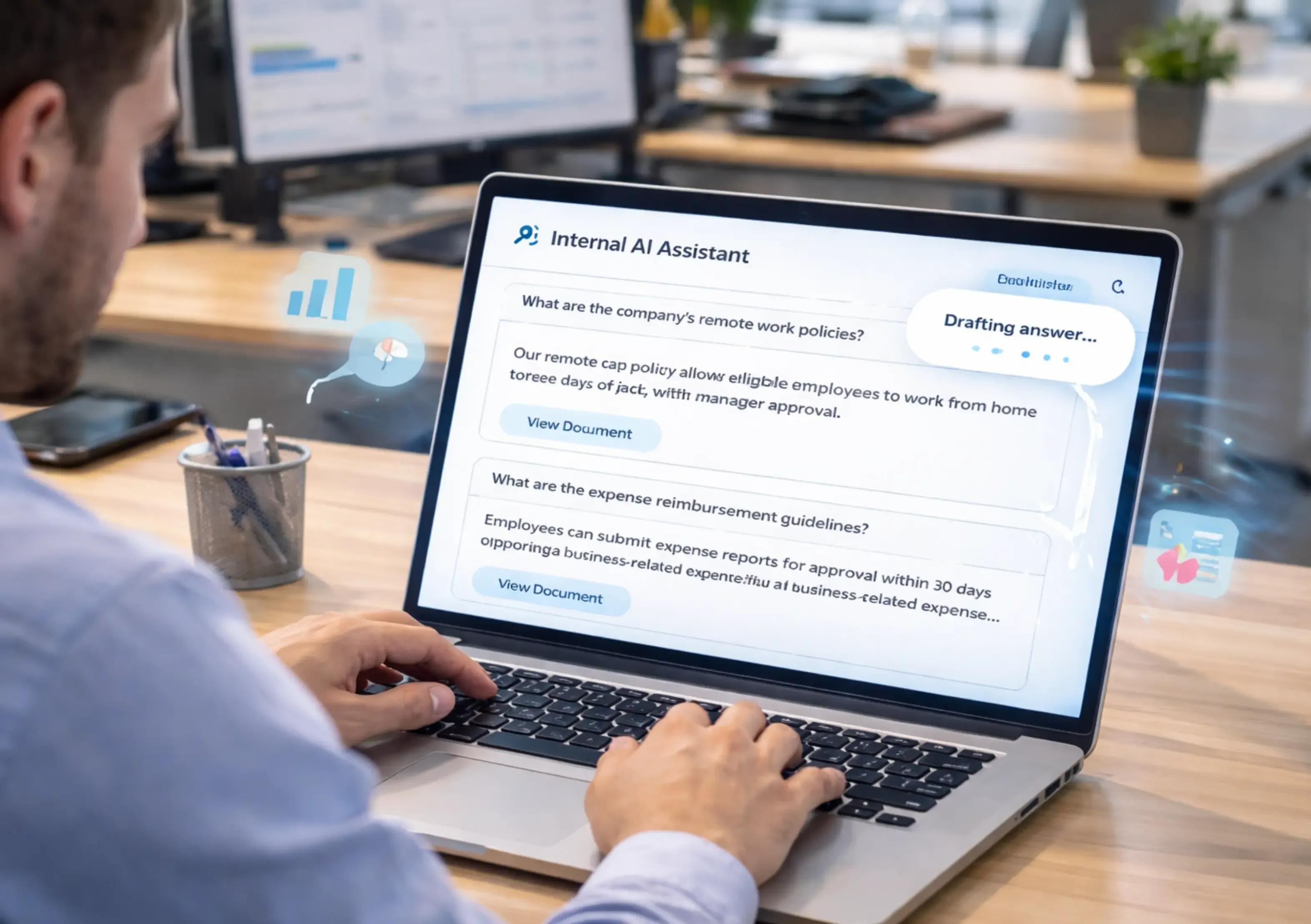
Organisations are increasingly building their own internal AI tools trained on policies, documents, standard operating procedures and historical decisions. These systems act like an internal knowledge companion. Staff can ask questions, retrieve guidance or generate content based on the organisation’s own language and rules.
This reduces time spent searching for information and improves consistency across teams. Many UK organisations see this as the next generation of internal communications. Colleges, law firms, local authorities and private companies are already using internal AI oracles to help employees get answers quickly and improve decision making.
8. Productivity Gains Reshape Roles rather than Replace Workers
Despite common fears, the data from early adopters shows that AI’s biggest impact is task reduction, not large‑scale job cuts. Teams that use AI report fewer repetitive tasks, faster turnaround times and more time for high value activities such as relationship management, creative thinking and problem solving.

This is especially relevant as UK organisations face pressure to increase productivity without significantly expanding headcount. New roles are emerging in AI enablement, workflow design and human oversight. Organisations that invest in reskilling and transparent communication are seeing healthier adoption and better outcomes. This trend is visible across industries, from education to manufacturing to professional services.
9. Governance becomes Non‑Negotiable

As AI becomes embedded in core operations, governance is shifting from optional guidance to a required organisational competency. Leaders are creating clear frameworks that specify where AI can be used, which risks must be monitored, who approves deployments and how data is handled.
These AI governance frameworks help UK organisations build trust with customers, regulators and partners. The most successful organisations in 2026 treat governance as an enabler rather than a blocker. They build safe experimentation environments and introduce lightweight approvals that allow teams to innovate responsibly.
10. AI Roadmaps move from Ambition to Activation
2026 marks the shift from theory to action. Instead of producing lengthy, abstract AI strategies, organisations are identifying two or three workflows that can deliver measurable results within a quarter. Leaders focus on outcomes like faster document processing, reduced customer wait times or improved forecasting accuracy. This practical approach is increasingly common, where organisations are looking for tangible wins rather than big‑ticket transformation programmes. Successful organisations start small, measure clearly and scale what works. This approach reduces hype, builds confidence and accelerates enterprise‑wide adoption. It also prevents teams from getting stuck in never‑ending planning cycles.
Conclusion
2026 is not just another year of AI hype. It is a year where strategy, technology and practical application are converging. These ten trends reflect what we are seeing inside real UK organisations that are moving from plans to impact. For leaders navigating economic pressure, energy concerns and workforce uncertainty, the message is clear. The organisations that act now will define the competitive landscape for years ahead.
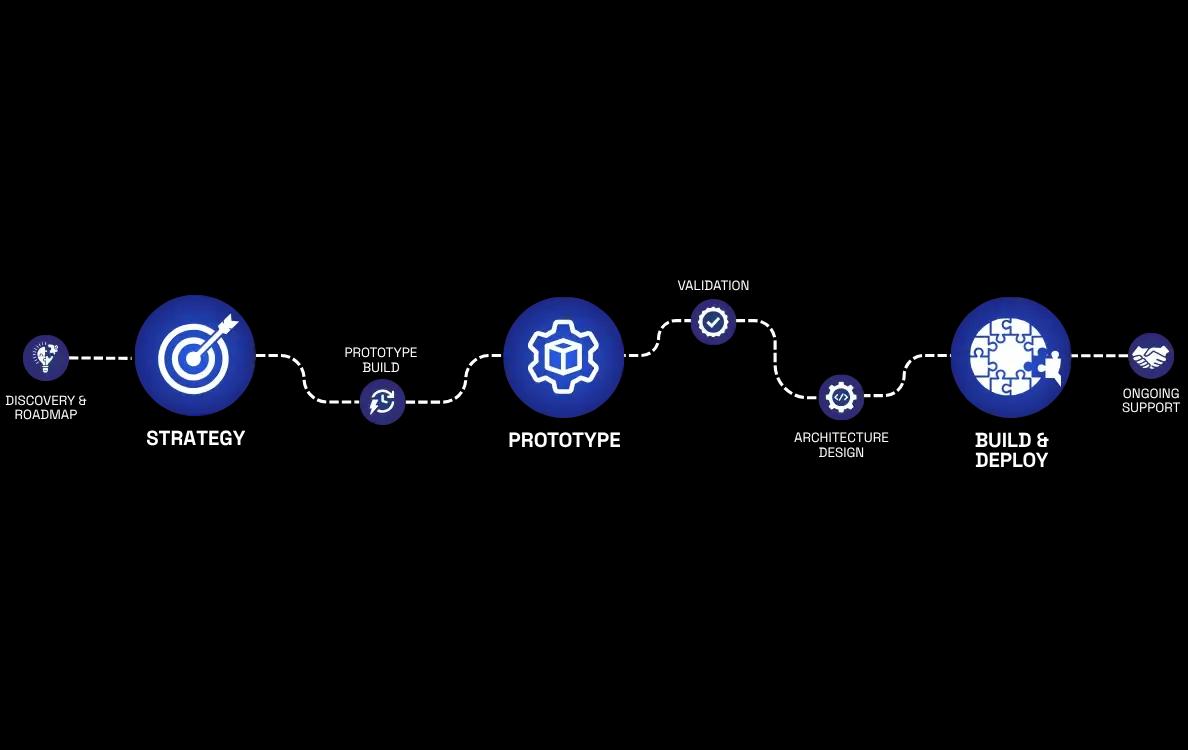
If you want support designing or deploying AI systems, ADSP specialises in building agentic AI tailored to your organisation’s data, processes and governance requirements. From readiness assessments to rapid prototypes and secure production deployments, our team helps you unlock real value quickly.

Start your AI Journey Today
Find out if your problem can be solved with AI.
Book a Free Discovery Call
Discover more AI Insights and Blogs

Transforming Satcom Design with Generative AI
Delivering next-generation satellite design with the European Space Agency.
Read More
.webp&w=3840&q=75)
What Makes AI Agents Different from Chatbots?
From chatbots to AI Agents: understanding the next generation of intelligent automation.
Read More

AI Governance - All you need to know
Learn the essentials of ethical AI governance to build secure and transparent AI systems.
Read More